
What you get
A phone system, an AI receptionist, and the customer record in between.
One account answers the calls, sends the texts, keeps the contacts and bills you once. Everything below is in the product today — we keep a written audit of this page against the code, and anything that is not finished is not on it.
Answering
Every call gets answered.
By a person, by a menu you drew yourself, or by an AI receptionist that books the appointment, takes the message, and hands the caller to you with a briefing already on the screen.
An AI receptionist that does things, not just talks. It books on your real calendar, takes a message, opens a ticket, captures a lead, sends a text, checks whether you are open, and transfers to the right person — all mid-call, with a hard limit on what it is allowed to touch.
It learns your business from your business. Paste your policies, upload a PDF or a Word file, or point it at your website and let it read up to fifty pages. Afterwards it shows you the questions callers asked that it could not answer.
Call flows you draw. Menus, hunt groups, time-of-day and holiday routing on a canvas. Save a draft, place a test call to your own phone, then publish. Every version is kept and you can go back.
Queues and ring groups. Ring everyone at once, or the person idle longest, or round-robin, or in priority order, with hold music and an overflow that lands on voicemail or another extension instead of nowhere.
Hours that hold, and voicemail that arrives. Name as many schedules as you have, each in its own timezone, with holiday exceptions. Voicemail is emailed to whoever was actually being rung, not to a shared box nobody opens.
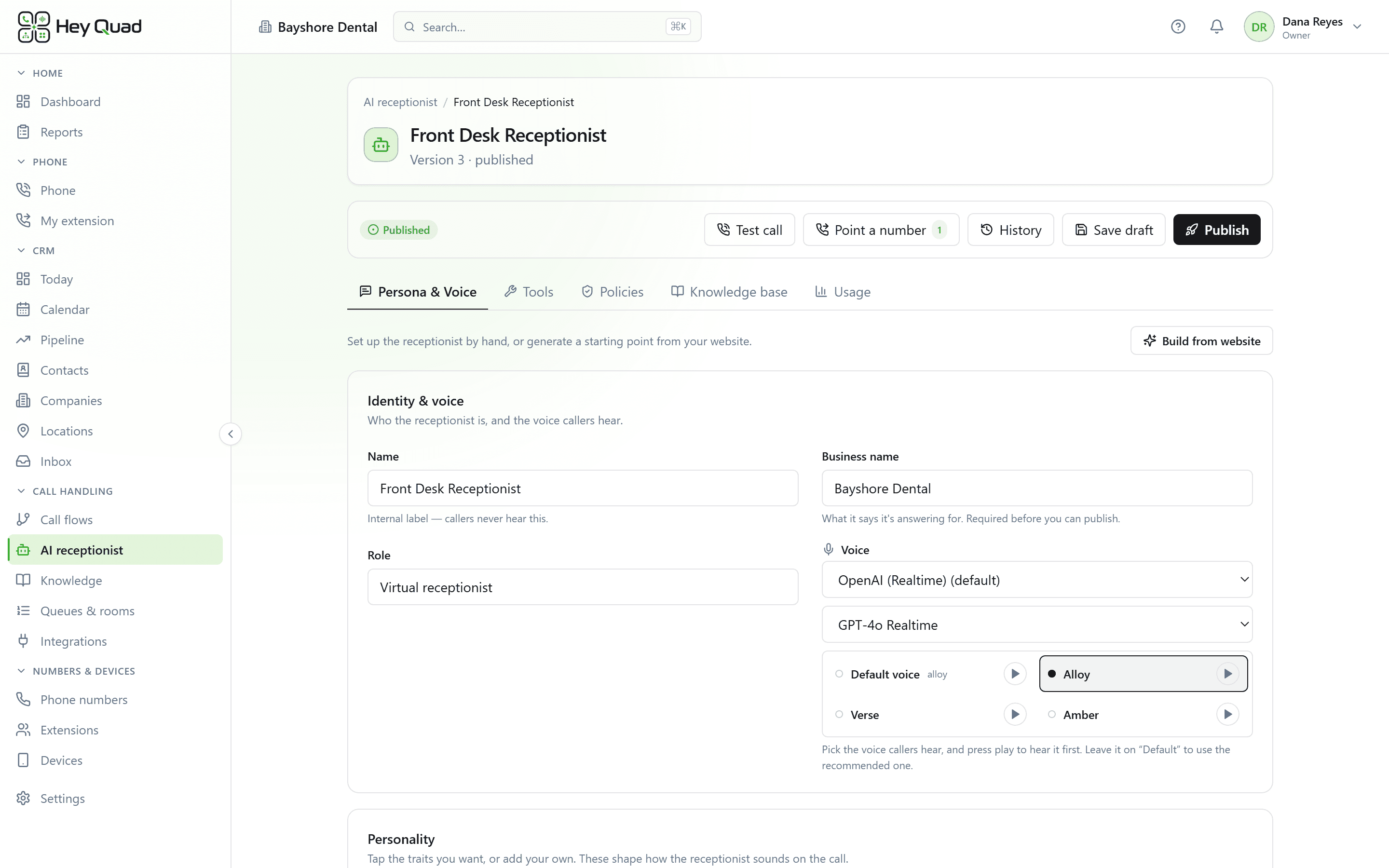
The AI receptionist is an add-on with its own pool of included minutes, in three sizes. What each one costs and how many minutes it carries is on the pricing page.
Phones
One extension. Every device.
Take the call in a browser tab or on the desk phone in front of you. Put someone on hold at the desk, pick them back up in the browser, and it is the same call.
The browser is a real phone. Hold, blind transfer, warm transfer, three-way merge, voicemail and texts, in any modern browser with nothing to install and no plugin.
Six brands of desk phone configure themselves. Yealink, Polycom, Grandstream, Cisco MPP, Fanvil and Snom. We generate one signed configuration URL per phone; it pulls its own lines, credentials and message light on boot. Anything else that speaks SIP registers with credentials you can reveal and rotate.
Ring order, per person. Ring every one of somebody’s devices at once, or in a sequence with your own delays between them. No answer forwards to voicemail, to an outside number, or to another extension.
Your numbers, your caller ID. Search for a number and buy it in the console, or bring the ones you have — porting in and out, with the carrier submission, the exceptions and the resubmissions handled here. Each extension shows a caller ID picked from the numbers you own.
The same phone off the desk. An Android app, a Windows desktop app and a Chrome side panel all run the same call engine as the browser. None of the three is packaged for public download yet, so ask and we will get you a build.
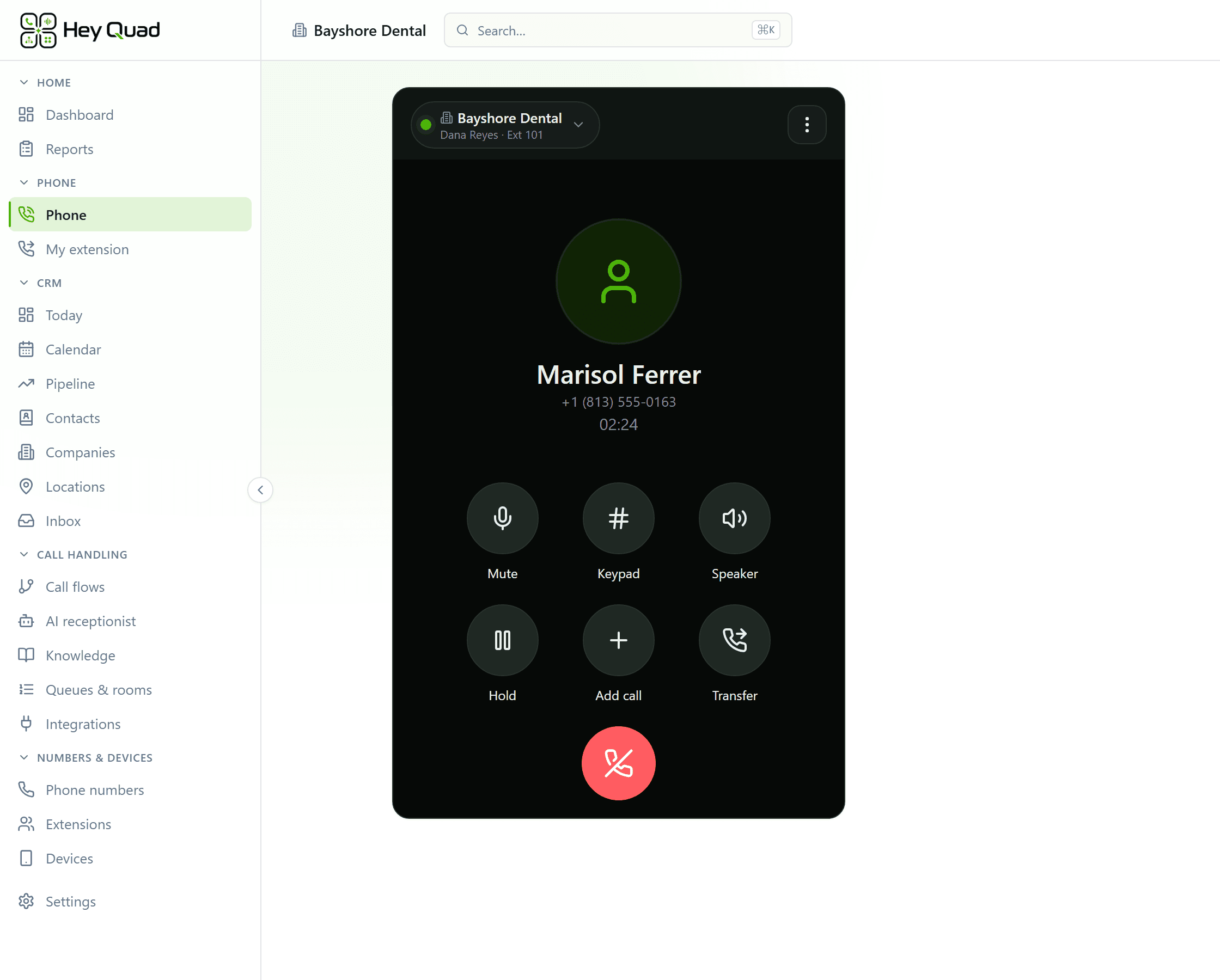
Emergency calling on an internet phone is not the same thing as on a landline, and pretending otherwise is how people get hurt. What it does and does not do is written out in our 911 disclosure, and we go through it with you before you go live.
Texting
Customers text. Answer from the same place you take calls.
Send and receive texts and picture messages on your business number, from the browser or your phone, in the same product that takes the calls. Every seat includes 250 texts a month, pooled across your team.
Texts and pictures. Send and receive SMS and MMS on your business number. Every thread sits beside the call history for the same person, so you are not switching apps to find out what was already said.
One inbox for the whole team. Texts, voicemails and tickets in a single list. Take a thread, assign it to somebody, close it. Point a number’s incoming texts at one extension or at a queue.
What's included. Every seat comes with 250 texts a month, pooled across the whole team. Texts people send you are free and never touch the pool.
STOP means stop. A STOP is honored the moment it arrives, enforced on every path that can send, and it outlives the account it was given to. Marketing texts additionally need consent on file, stay inside quiet hours, and are capped per day.
Carrier registration, guided. US carriers require every business number to be registered before it can text. We run the brand, the campaign and the number assignment for you: $20 once and $2 a month, at carrier cost plus a small fee.
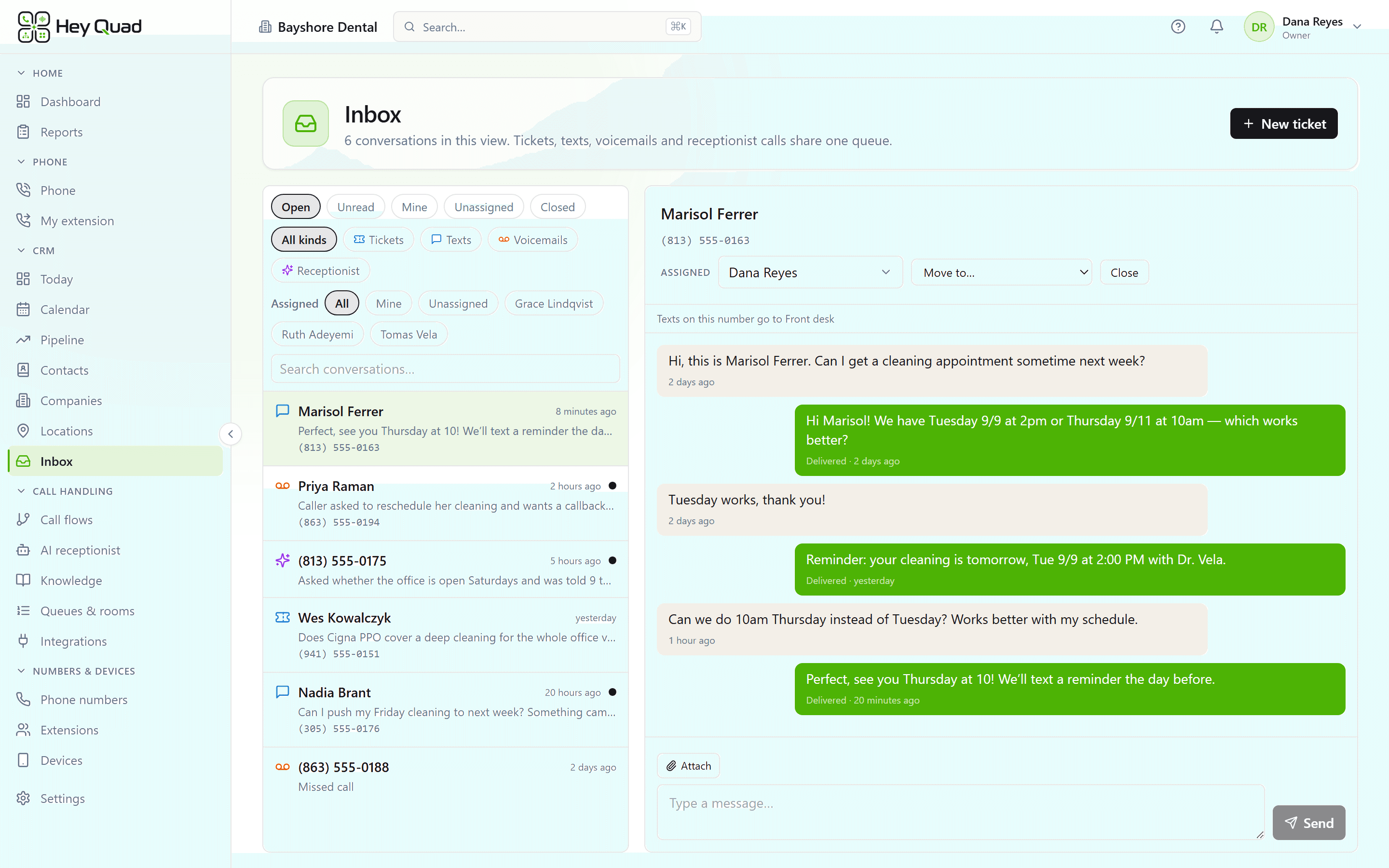
Texting and the shared inbox are both part of the seat. There is nothing to add on to send a text or to answer one as a team.
Customers
The phone already knows who is calling.
So it may as well keep the record. Contacts, tickets and appointments live in the same product as the phone, which means a call, a text and a booking land on one timeline without anybody copying anything anywhere.
The record on screen before you say hello. As it rings you get the caller, their open tickets and their next appointment — and if the AI took the call first, its summary of what they want and what it already did.
One timeline per customer. Calls, texts, tickets, appointments and notes in order, on the person, the company or the property they belong to.
Tickets people answer by replying. Open one from a call, a text or a web form. The customer replies to the email or texts back, and the reply lands on the ticket instead of in somebody’s personal inbox.
Real appointments. Availability rules, conflict detection that offers the next open slots instead of failing, calendar invites, and reminders — an email the day before and a text two hours out. The AI receptionist books into this same calendar.
Your own fields. Add the fields you actually use to contacts, companies and properties, and set the pipeline stages a lead moves through.
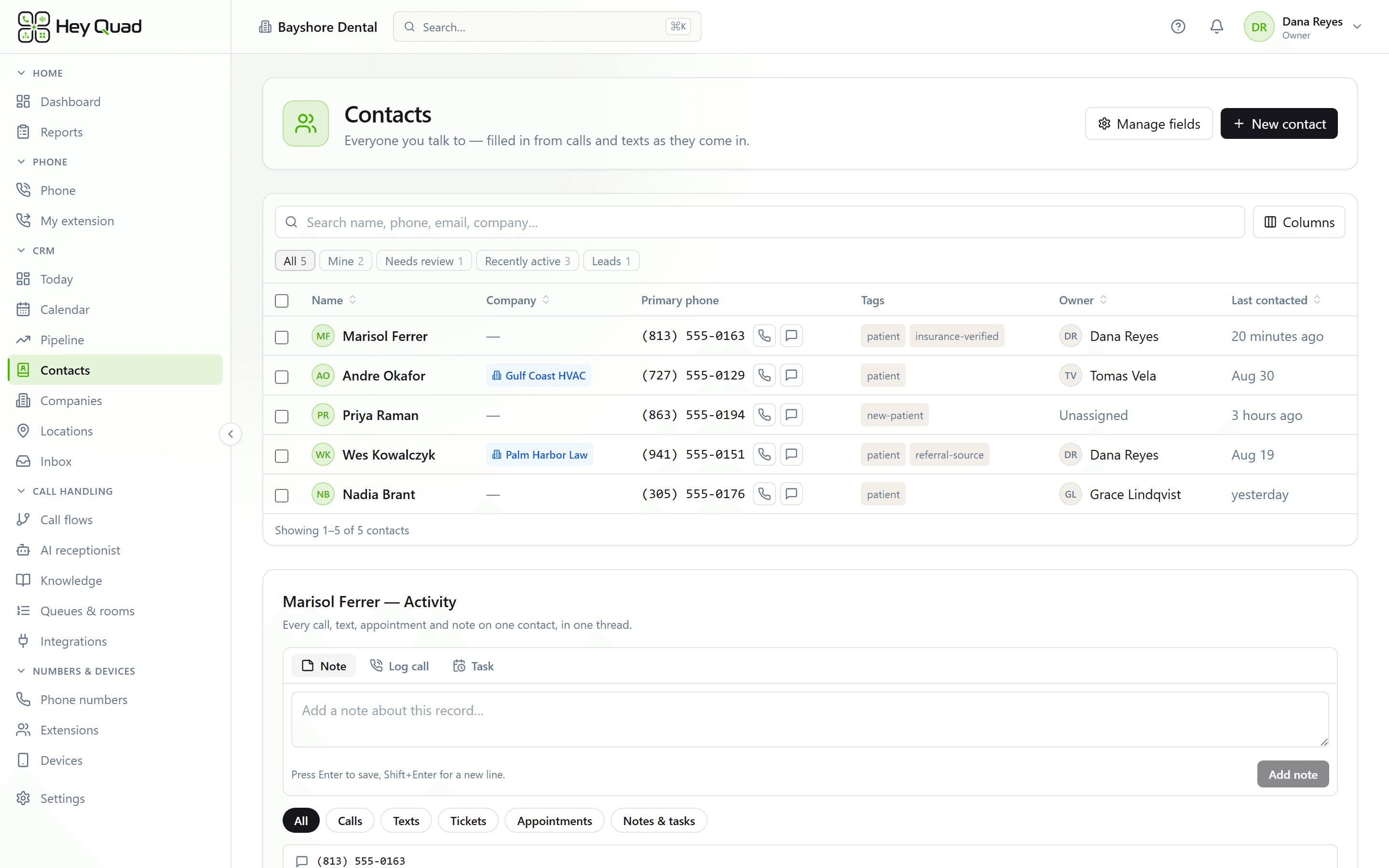
Contacts, tickets, appointments and the screen pop come with every seat, which is also what lets the AI receptionist book an appointment or open a ticket without anything else being switched on.
Reports and recording
Every call, every text, every dollar.
Seven reports built on the same call records the invoice is built from, because we meter from our own records rather than reading a carrier's back to you.
Seven reports, all exportable. Call history, queues, agents, the AI receptionist, the menu funnel, usage and spend, and messages. Every one of them exports to CSV.
Find the menu that loses people. The funnel report counts, node by node, who reached it, what they pressed, and who hung up right there — so a bad menu is a number instead of a hunch.
Live, and on the wall. Who is ringing and who is on a call, right now, on dashboards you arrange yourself. Generate a read-only token and leave one on a screen in the office.
Recording on your terms. Off, from the moment the call answers, or only once a person picks up, with per-queue overrides and a pause you can drop into a flow before somebody reads out a card number.
Deletion you set and we carry out. Choose how long recordings, transcripts and messages live. The purge deletes the stored file first and the database row second, so nothing is left orphaned in a bucket.
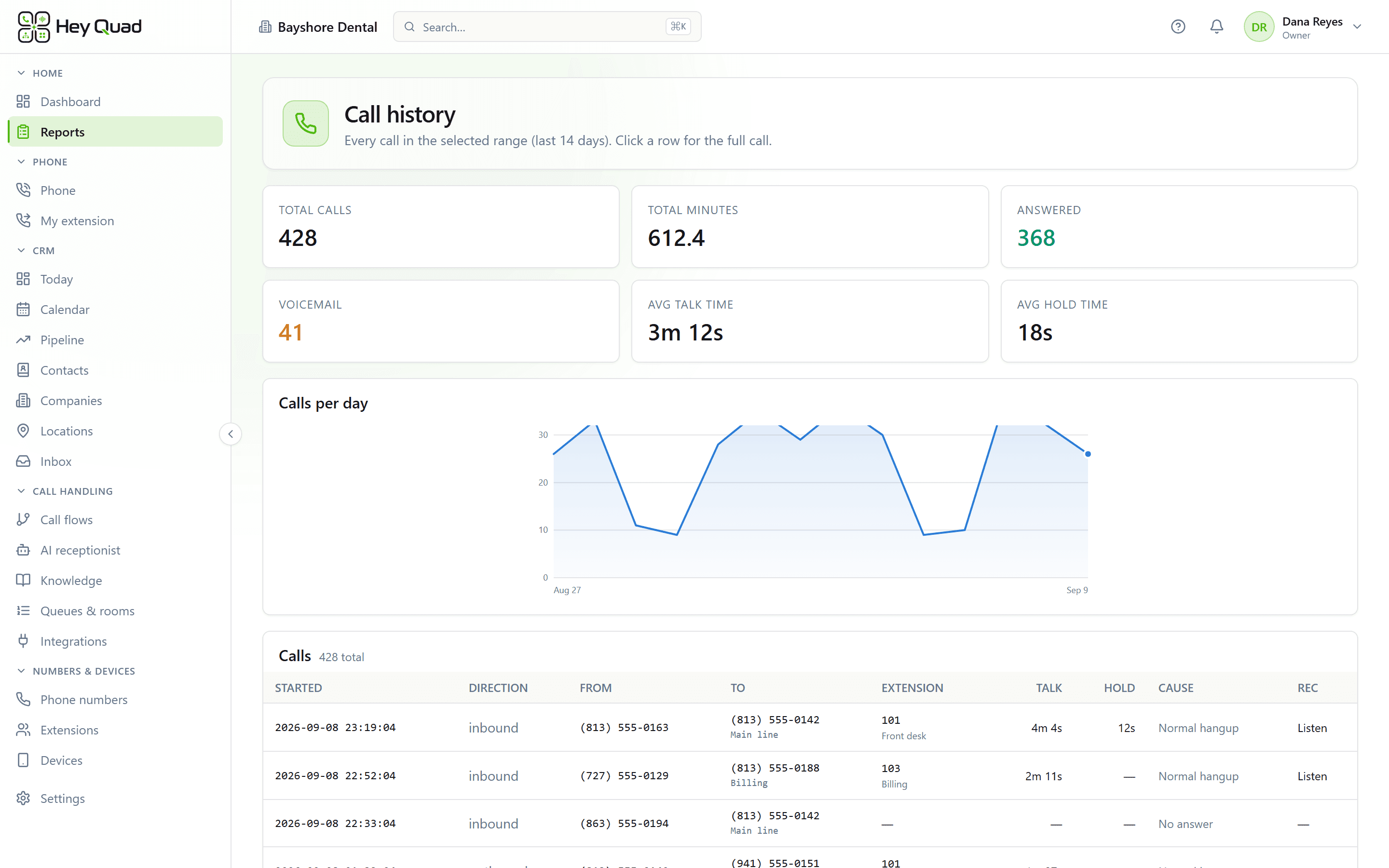
The reports and call recording are both part of the seat. Calls the AI receptionist handles also carry a transcript and a written summary of what the caller wanted — calls a person handles are recorded, not transcribed.
Trust
The parts that are easy to promise and hard to do.
Written down, checked against the code that implements them, and short a few things on purpose.
Isolation the database enforces. Every table holding customer data runs Postgres row-level security in FORCE mode. The only path to a row is a transaction opened for one organization, which means a cross-tenant read is not reachable even from our own application code.
A disclosure your callers cannot skip. Calls routed through a flow open with a recording and AI disclosure played from a template we control, and every play is written to an append-only ledger. You can add your own wording before and after it.
Consent, and a STOP that sticks. A written-consent record is required before a marketing text goes out, and a suppressed number is suppressed on every send path — including the ones a person drives by hand.
Your data, out again. Export the whole organization as a single archive whenever you want it. Retention windows are yours to set, and sensitive actions land in an audit log you can read and filter from your own settings.
What we do not have. No SOC 2 report and no audit under way. If you handle protected health information there is a real BAA you accept yourself during onboarding, and healthcare accounts stay blocked from going live until every vendor in the chain is covered — a gate we enforce in code rather than a promise.
Where it runs, who every subprocessor is, how backups work and what we do not have is on the security page.
And the rest of it.
Smaller things, all of them real, none of them big enough to earn a section.
Conference rooms
Dial-in rooms with mute on entry, an entry and exit tone, and a supervisor who can listen in, whisper to one side, or join.
Connect any API you already have
Import an OpenAPI file, a Postman collection or a single curl command, store the credentials encrypted, and call the result mid-call from a flow. The credentials never appear in the flow itself.
Roles and permissions
Owner, admin and member over about thirty-five separate permissions, so the person who answers phones is not the person who can change the bank details.
API tokens
Hashed at rest, shown to you exactly once, optionally expiring, revocable — and a token can never mint another token.
Help that knows where you are
Twenty-five written guides, a reference page for every block in the flow editor, and a question mark in the console that opens the article for the page you are on.
A command line
hq drives flows, call records, contacts, numbers and devices from a terminal. It is not packaged for download yet; ask and we will get you a build.
See what it costs for your business.
Tell us about the business and you get your price on this page. If we do not cover your state yet we say so, and take your details for when we do.
Every seat includes the shared inbox, the customer record and call recording. The AI receptionist is the only part priced separately.
Tell us about the business
Or read the full price list first. How we handle your data